npm @leclap/mcpstdioMITupdated 13d ago
Deterministic, on-device, agent-callable video — composed by prompt or by hand.
Was kannst du mit LeClap machen?
LeClap
Deterministic, on-device, agent-callable video — composed by prompt or by hand.
Describe a video in one JSON template — sections, filters, music, overlays — then render that same template on a phone (React Native, on-device) or in the browser (WebAssembly). No upload, no server, no generative model: the render is deterministic and reproducible, not sampled.





Quick start · Templates · Library API · Architecture · Docs
✨ What is LeClap?
One JSON template. It renders on Node, in the browser via WebAssembly, and natively on-device on React Native — same template, same pipeline, reproducible run after run on a given platform. No upload, no server, no generative model.
🎥 Demo
Two looks at LeClap — a finished clip rendered from a single JSON template, and the mobile app composing one fully on-device.
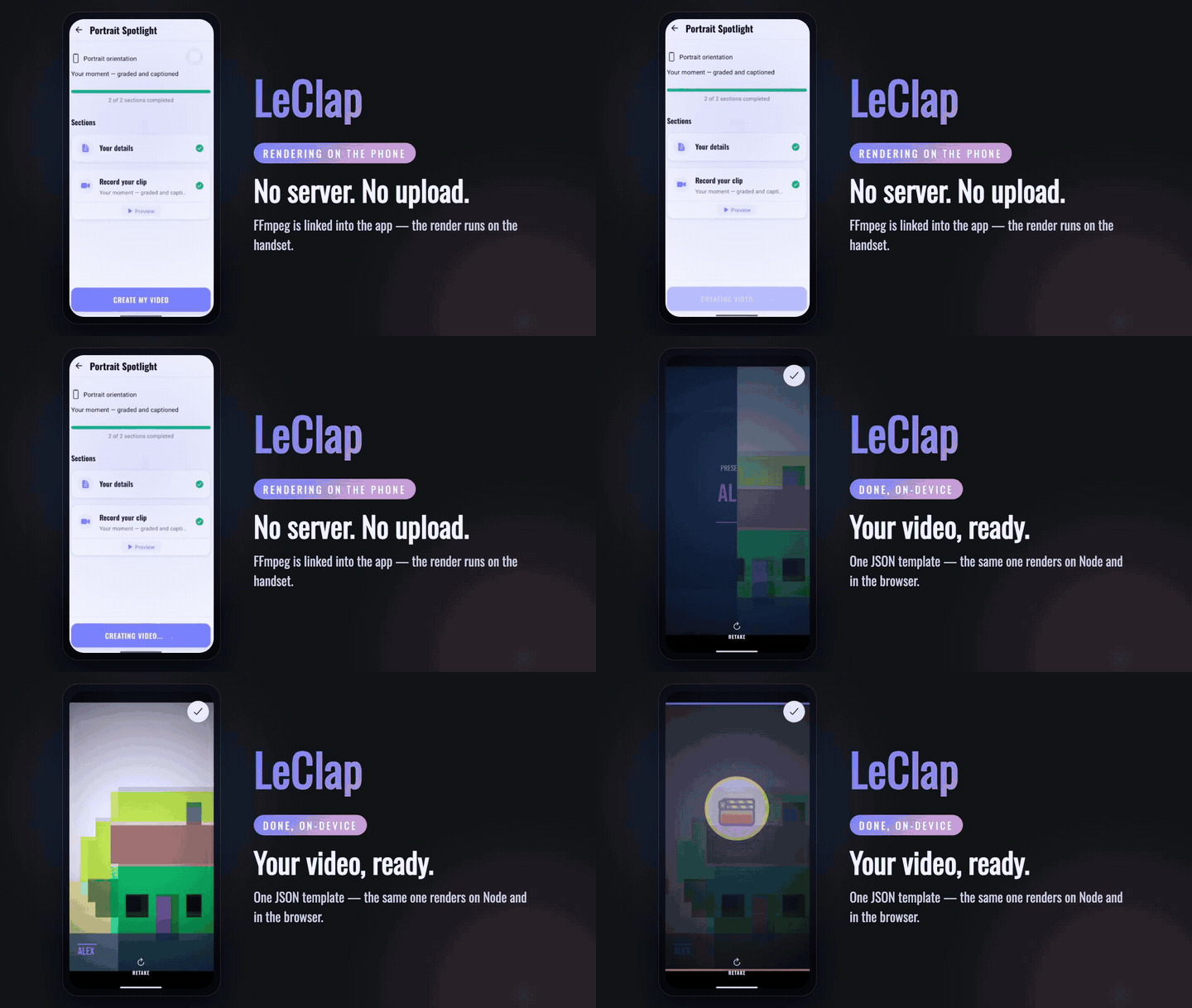
🤔 Why LeClap?
Generative tools can't reproduce a result twice. Cloud renderers can't run in your user's pocket. Remotion renders without a server, but needs a browser engine to do it — LeClap links FFmpeg into the app itself.
| LeClap | Remotion | Shotstack | Generative video | |
|---|---|---|---|---|
| Renders in a native app, no browser | ✅ React Native, FFmpeg linked in | ❌ needs a WebCodecs browser | ❌ cloud API | ❌ cloud API |
| Runs with no server | ✅ | ✅ in the browser, since 4.0.491 | ❌ cloud API | ❌ cloud API |
| Same input → same output | ✅ per platform¹ | ✅ if you avoid randomness | ⚠️ not documented | ❌ sampled, not rendered |
| Authored by an AI agent | ✅ MCP | ⚠️ an LLM writes React code | ✅ MCP (cloud) | ✅ prompt |
¹ Per platform, not across them: Node and the browser encode with libx264, Android with libopenh264, iOS with h264_videotoolbox, and the on-device build drops boxblur and rewrites eq→lutyuv. Same composition, different pixels.
LeClap vs Remotion → — the reasoning behind each row, the full caveats, every claim sourced to vendor docs, and when to pick Remotion instead.
🧰 Highlights
| Highlight | What it means |
|---|---|
| 🧩 Template-driven | One JSON descriptor → a complete video. No imperative FFmpeg wrangling. |
| 🌍 Runs everywhere | Node.js, browser (WASM), and React Native — one shared core, reproducible on each (the encoder differs per platform, see above). |
| 📹 Capture → compose → render | Record from the camera, trim/crop, mix music, add transitions, and render — captured, edited, and composed on-device. |
| 🤖 Agent-callable | An MCP server lets an AI agent author & render a template — no LLM in the output path, so it's rendered, not sampled. |
| 🎨 Premium out of the box | A bundled creative kit of polished, on-device-safe templates — by prompt or in the visual builder. |
| 🧱 Typed & validated | Zod-validated templates, strict TypeScript, dependency-injected architecture. |
🚀 Quick start
💡 Recommended: mise.
mise installprovisions the exact pinned toolchain — Node 24, pnpm 11, FFmpeg 8.1.1, and Rust — so every contributor and CI run identical versions. Managing versions yourself? Bring Node ≥ 24 and pnpm 11.
git clone https://github.com/heristop/leclap.git
cd leclap
mise install     # Node 24, pnpm 11, FFmpeg 8.1.1 + Rust
pnpm install
Then pick an app:
pnpm app:web      # web app — compiles videos in-browser (no server)
pnpm app:expo     # Expo mobile app — compiles fully on-device (no server)
Or use the CLI — @leclap/cli is the leclap dev tool:
npx @leclap/cli init my-video         # scaffold a starter project
npx @leclap/cli render template.json  # render it (`leclap diagnose` checks your FFmpeg)
Or drive it from an AI agent: the @leclap/mcp server exposes the engine as MCP tools — schema → validate → render — with no LLM in the output path.
📦 Monorepo
pnpm workspaces (apps/*, packages/*) — no turbo/nx. The root is a private orchestrator (leclap); ffmpeg-video-composer, @leclap/cli, and @leclap/mcp are published to npm. The web and mobile apps both run the same core — the mobile app drives it fully on-device via the embedded native engine (no server), the web app in-browser via WASM.
| Package | Description |
|---|---|
ffmpeg-video-composer |
The library — cross-platform composition engine (Node, browser, WASM). |
@leclap/cli |
The CLI — the leclap dev tool: scaffold (init), render, diagnose. |
@leclap/creative-kit |
Shared creative catalog — templates, partials, fonts, media, bundled assets. |
@leclap/mcp |
MCP server — the engine as agent-callable tools (schema/validate/compose/probe). |
@leclap/web |
React 19 + Vite + Tailwind — in-browser FFmpeg via WASM (reference). |
@leclap/expo |
Expo / React Native — on-device compiles via the native engine (reference). |
ffmpeg-engine |
Rust engine embedding FFmpeg fftools for on-device compiles. |
🧩 Templates & library
A template is a Zod-validated JSON descriptor — a global block plus an ordered list of sections, each a clip with its own inputs → maps → filters pipeline and {{ variable }} placeholders. Start from a creative-kit template and tweak text, colors, and media — by prompt (MCP) or in the visual builder.
- 📖 Template configuration reference — global config, sections, the FFmpeg pipeline, placeholders.
- 📥 Use it as a library — install, the
compile()API, entry points (Node / browser / RN), and automatic FFmpeg detection.
📚 Documentation
- 🌐 Descriptor reference (web) — the full, schema-driven descriptor reference, one page per topic (sections, transitions, looks, grade, motion, audio, captions, filters, examples, JSON Schema).
- 🧩 Template Configuration — the template JSON reference.
- 🏗 Architecture — system architecture and design patterns.
- 🔧 FFmpeg Fallback Strategy — how automatic FFmpeg detection works.
- 📱 On-Device Compilation — the serverless Expo compile pipeline.
- 🤖 AGENTS.md — repo layout, commands, and conventions for contributors and AI agents.
🤝 Contributing & License
Issues and PRs welcome. Keep changes formatted (pnpm fmt) and lint-clean (pnpm lint) before committing. The code is licensed under the MIT License.
Brand & trademark. The MIT License covers the code, not the brand. The LeClap name and logo are trademarks of Alexandre Mogère — you can fork and reuse the code freely, but please give your fork a different name and don't imply endorsement. See TRADEMARK.md for details.
Installation
LeClap zu deinem Client hinzufügen. Wähl den, den du nutzt.
claude mcp add mcp -- npx -y @leclap/mcpcodex mcp add mcp -- npx -y @leclap/mcpamp mcp add mcp -- npx -y @leclap/mcp{
"mcpServers": {
"mcp": {
"command": "npx",
"args": [
"-y",
"@leclap/mcp"
]
}
}
}Add to `claude_desktop_config.json`, then restart Claude Desktop.
{
  "mcpServers": {
    "mcp": {
      "command": "npx",
      "args": [
        "-y",
        "@leclap/mcp"
      ]
    }
  }
}
Add to `~/.cursor/mcp.json`, or `.cursor/mcp.json` for a single project.
code --add-mcp '{"name":"mcp","command":"npx","args":["-y","@leclap/mcp"]}'Or add the block manually to `.vscode/mcp.json` under `servers`.
{
  "mcpServers": {
    "mcp": {
      "command": "npx",
      "args": [
        "-y",
        "@leclap/mcp"
      ]
    }
  }
}
Add to `~/.codeium/windsurf/mcp_config.json`.
{
  "mcpServers": {
    "mcp": {
      "command": "npx",
      "args": [
        "-y",
        "@leclap/mcp"
      ]
    }
  }
}
Add to `cline_mcp_settings.json` via the MCP Servers panel.
{
  "mcpServers": {
    "mcp": {
      "command": "npx",
      "args": [
        "-y",
        "@leclap/mcp"
      ]
    }
  }
}
Add to `~/.gemini/settings.json`.
{
  "mcpServers": {
    "mcp": {
      "type": "local",
      "command": "npx",
      "args": [
        "-y",
        "@leclap/mcp"
      ],
      "tools": [
        "*"
      ]
    }
  }
}
Add to `~/.copilot/mcp-config.json`, or run `/mcp add` inside the CLI.
{
  "context_servers": {
    "mcp": {
      "command": {
        "path": "npx",
        "args": [
          "-y",
          "@leclap/mcp"
        ]
      }
    }
  }
}
Add to your Zed `settings.json`.
npx -y @leclap/mcpRun `goose configure`, choose **Add Extension → Command-line Extension**, and paste this command.
Score
39 / 100
Unvollständig
- Dokumentation25/25
- Pflege19/25
- Vertrauen13/20
- Funktionsumfang0/15
- Installation12/15
- Documents what it does and how to connect
- Has a resolvable package or endpoint
- Exposes at least one tool, prompt or resource
- README has substantive content
- Includes a code example
- Documents its configuration
- Mentions credentials or security posture
- Last commit 5 days ago
- Has a release history
- Repository is not archived
- Licensed MIT
- Namespace verified in the official MCP registry
- Claimed by its owner
- Published under an organisation
- 0 tool(s) documented
- Provides prompt templates
- Provides resources
- 12 documented install method(s)
- Published to a package registry
- Offers a hosted endpoint — no local install
Versionsverlauf
| Versionen | Veröffentlicht |
|---|---|
| 0.3.4Aktuell | 24. Aug. 2026 |